
Harry Houdini: 100 Years After the Death of the World’s Greatest Escape Artist |
On Halloween 2026, a century after Houdini died, his life still blurs the line between danger, showmanship, skepticism and legend |
On Halloween 2026, exactly 100 years will have passed since Harry Houdini died in a Detroit hospital at age 52.
For a man who built his fame by escaping handcuffs, prison cells, locked boxes, straitjackets and tanks of water, the date of his death helped create one final piece of mythology.
But the real story of Houdini is more interesting than the legend.
From Ehrich Weisz to Harry Houdini
He was born Ehrich Weisz in Budapest on March 24, 1874, and came to the United States with his family as a child.
The family lived for a time in Appleton, Wisconsin, before eventually settling in New York.
Young Ehrich was athletic, fascinated by performance and willing to work relentlessly at whatever could get him onto a stage.
He adopted the name Houdini in tribute to the celebrated French magician Jean-Eugène Robert-Houdin, then turned himself into something far bigger than an ordinary conjurer.
In 1894 he married Wilhelmina “Bess” Rahner, who became both his wife and stage partner.
Together they performed as The Houdinis, with routines that included a fast-moving substitution illusion known as Metamorphosis.
The breakthrough came when Houdini stopped trying to look like every other magician and made escape itself the attraction.
In 1899 vaudeville manager Martin Beck encouraged him to focus on handcuff escapes, and the advice changed his career.
By the early 1900s, Houdini was touring internationally as the “Handcuff King,” challenging police departments to lock him in their strongest cells and restraints.
The escapes were only part of the act.
Houdini understood publicity with almost modern precision, turning outdoor stunts, newspaper coverage and public challenges into advertisements for his theater appearances.
Danger Becomes the Show
In 1908 he introduced the Milk Can Escape, climbing into an oversized metal can filled with water before assistants secured the lid.
The audience watched a human being disappear into a container that looked more industrial than theatrical, and the suspense came from the same question that powered nearly every Houdini performance: how long could a man survive if the escape failed?
|
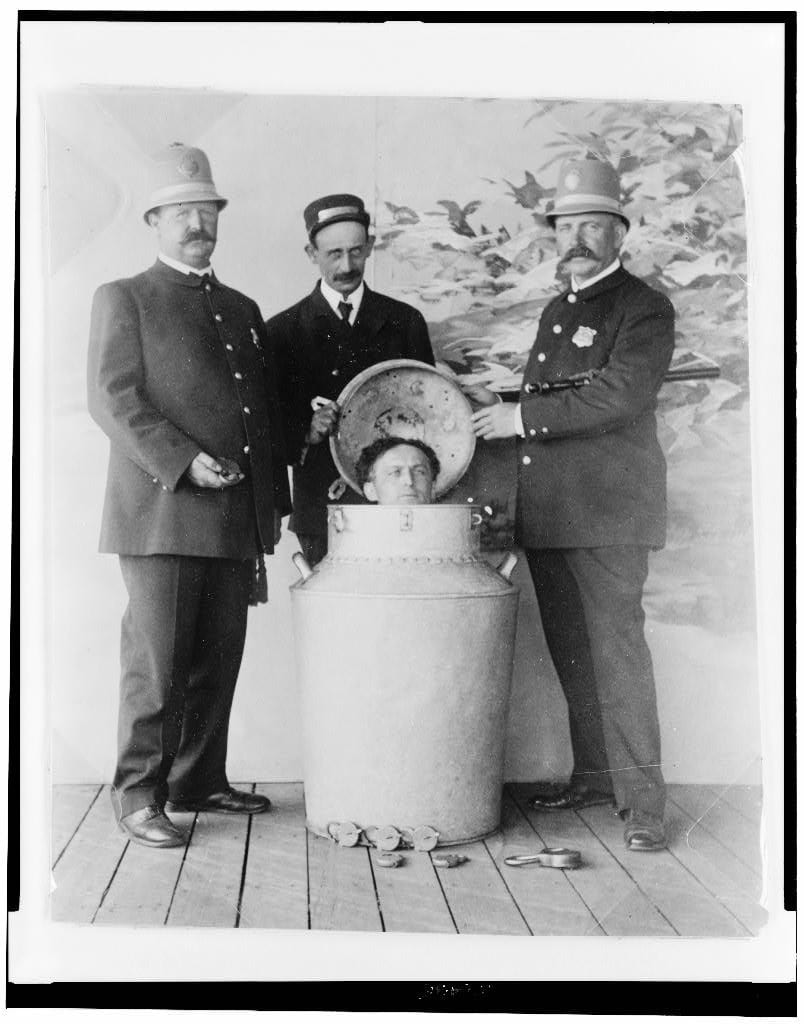 Houdini performing his Milk Can Escape, circa 1908. He climbed into a giant water-filled metal can before the lid was secured, then escaped while the audience waited through the apparent danger. Library of Congress / public domain. |
That same year, on April 30, Houdini performed one of his famous outdoor publicity escapes at Harvard Bridge in Boston.
He was photographed barefoot and bound in restraints beside the Charles River before making a manacled jump into the water and escaping beneath the surface.
The crowd did not simply watch a trick; it watched a public test of nerve staged to look like a brush with death.
|
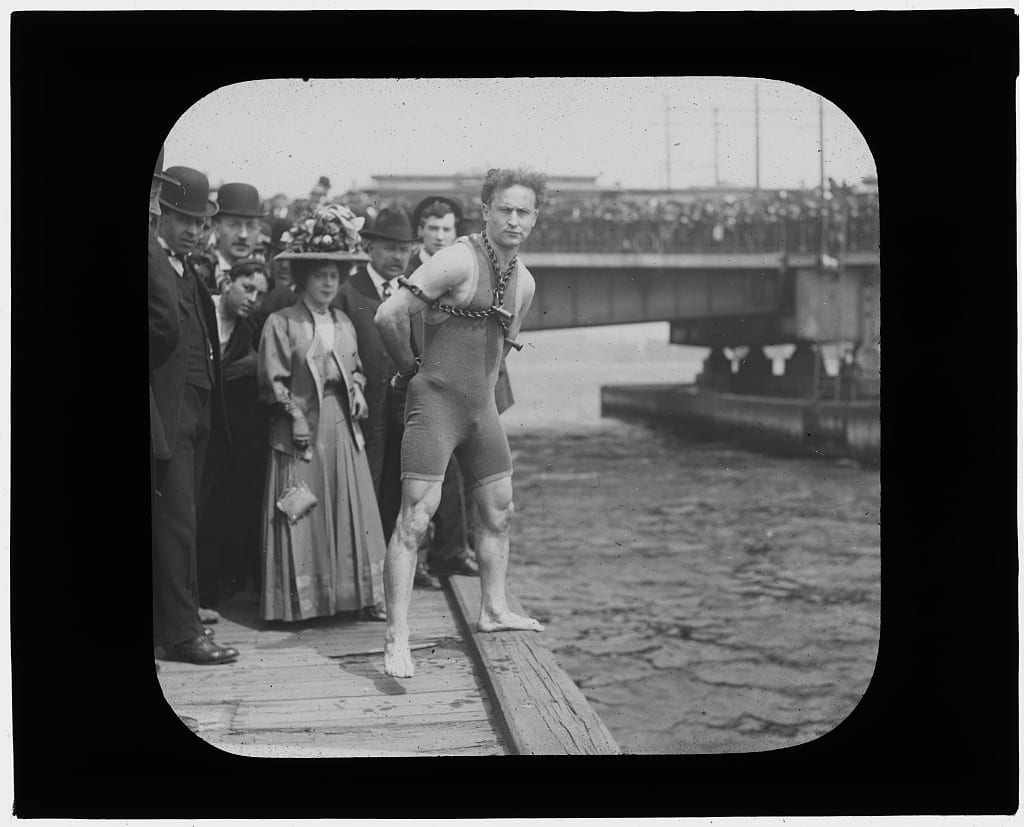 Houdini at Harvard Bridge in Boston on April 30, 1908, bound before a manacled jump into the Charles River. He escaped the restraints underwater as a crowd watched from the bridge. Library of Congress / public domain. |
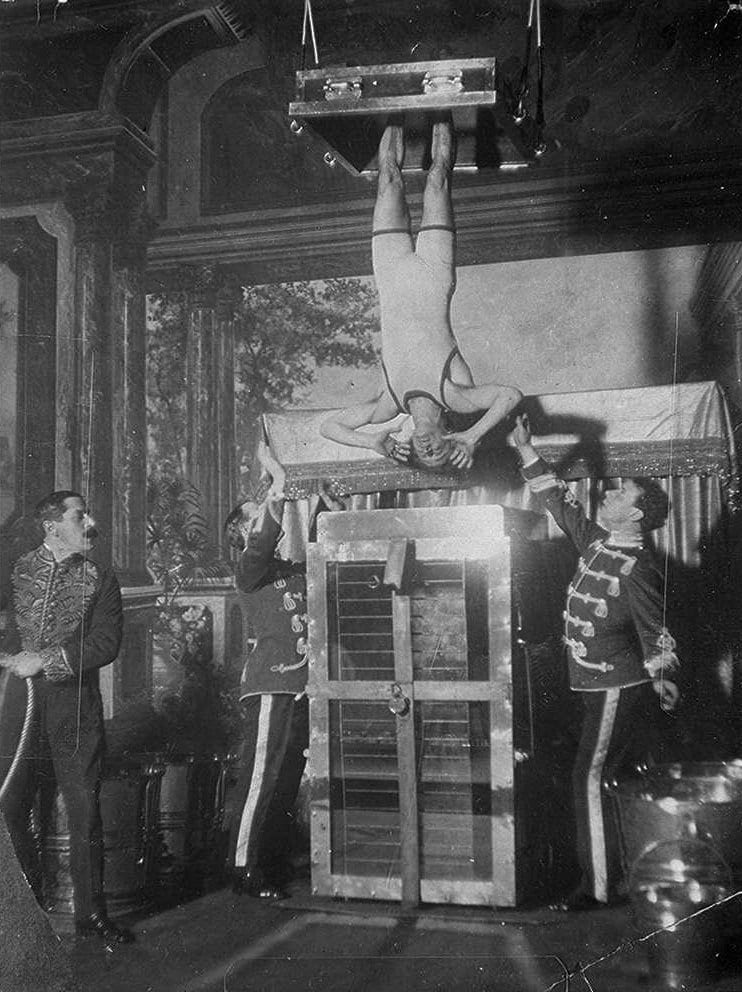
By 1913, Houdini was featuring the act most closely associated with his name: the Water Torture Cell.
His ankles were locked into stocks, he was turned upside down, lowered headfirst into a water-filled glass-fronted cabinet and locked inside.
The audience could see the water and the trapped performer, which made the illusion feel brutally simple even though the routine required precise preparation and technique.
Houdini also turned the straitjacket into a spectacle by having himself suspended upside down from buildings while crowds gathered below.
A 1922 photograph from Washington, D.C., shows him hanging high above a dense crowd outside B.F. Keith’s Theatre, transforming a restraint associated with confinement into a public theater event.
Houdini’s genius was not that he removed risk from magic, but that he made the audience feel the risk before he made the escape look inevitable.
|
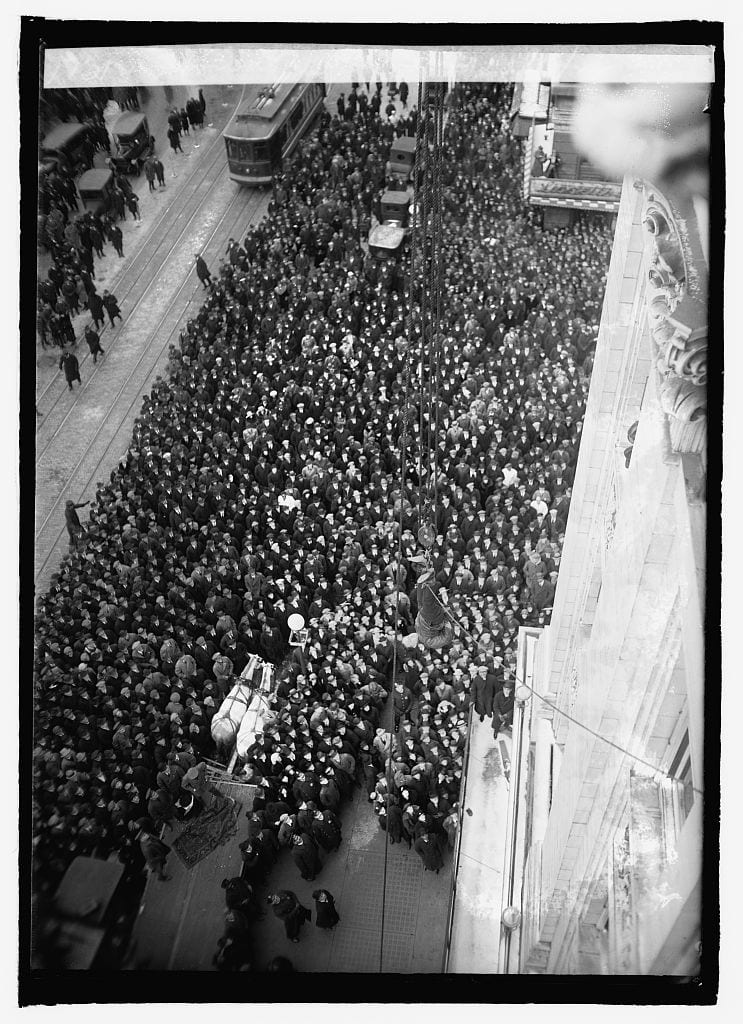 Houdini hangs upside down outside B.F. Keith’s Theatre in Washington, D.C., in 1922 during a suspended straitjacket escape. Thousands gathered below while he worked free high above the street. National Photo Company / Library of Congress, no known restrictions. |
The Magician Who Hunted Fake Ghosts
Later in life, Houdini became nearly as famous for exposing fraudulent spiritualists as he was for escaping restraints.
His interest in the subject was personal as well as professional.
After the death of his beloved mother, Cecelia, in 1913, Houdini wanted to know whether genuine communication with the dead might be possible.
What he repeatedly found instead were methods he recognized from the magician’s toolbox: hidden mechanisms, coded signals, manipulated photographs, concealed assistants and theatrical misdirection.
During the 1920s he publicly challenged mediums and demonstrated how supposed spirit manifestations could be recreated through trickery.
His campaign placed him at odds with believers including author Sir Arthur Conan Doyle, whose friendship with Houdini deteriorated over spiritualism.
Houdini studied the subject obsessively and assembled a huge library on magic, psychic phenomena, spiritualism, witchcraft and related subjects.
After his death, thousands of volumes from that collection were left to the Library of Congress.
The Punches, the Appendix and a Century-Old Myth
The final days of Houdini’s life have been retold so many times that fact and legend are often mixed together.
Earlier in October 1926, Houdini had already fractured his ankle during a performance but continued touring.
On October 22, while in Montreal, a university student named J. Gordon Whitehead visited Houdini backstage and asked about the performer’s reported ability to withstand hard blows to the abdomen.
Whitehead struck Houdini several times before the magician had properly prepared his abdominal muscles.
Houdini was in obvious pain afterward, yet he continued performing and traveled on to Detroit.
On October 24, despite severe pain and fever, he gave what would become his final stage performance.
He was hospitalized afterward, and surgery revealed that his appendix had ruptured and infection had spread through his abdomen.
He died from peritonitis on October 31, 1926.
The famous claim that the punches killed Houdini is possible but not proven.
Medical historians have questioned whether the blows actually caused the appendix to rupture, and Houdini may already have been developing appendicitis before the backstage incident.
The better-supported conclusion is that he died from complications of a ruptured appendix after delaying treatment while continuing to perform.
The Final Escape That Never Came
Houdini had spent years exposing people who claimed to communicate with the dead, but he still left open one final test.
He and Bess agreed on a coded message that he would try to deliver if communication after death proved possible.
The key words became associated with the phrase “Rosabelle, believe.”
Bess participated in séances for years, including a widely publicized final attempt on Halloween 1936, the tenth anniversary of Houdini’s death.
No authenticated message ever arrived.
A century later, Houdini remains famous not because people still believe he possessed supernatural powers, but because he convinced audiences to feel, for a few breathless minutes, that ordinary human limits might not apply to him.
On the 100th anniversary of his death, that may be the most enduring Houdini illusion of all: the sense that the impossible is only waiting for someone stubborn enough to escape it.
Historical sources and images: Library of Congress Houdini overview, Water Torture Cell photograph, Harvard Bridge photograph, and 1922 suspended straitjacket photograph. |
Sponsored By: |

25 Comments
Join the conversation
Sad that he didn’t make it past 52. I always thought he was older when he passed.
All these years and people are still talking about him. That’s real staying power.
It’s cool Bess was part of the act too. Bet she was just as brave standing onstage hoping he got out.
Anyone else picturing an enormous milk can as the scariest thing ever? Just wild.
Makes you wonder what kinds of illusions magicians back then kept secret. Bet nobody really knew how he did it.
Interesting how quickly his career changed once he focused on escapes instead of just card tricks and stuff.
Appleton, Wisconsin! Gotta start somewhere, huh. Small town kid to legend.
He really turned risk and danger into art. Takes guts. Modern magicians don’t seem as daring.
He died on Halloween? Didn't know that. Makes all the myths sound even creepier.
That Metamorphosis trick must've been something to see live with both of them performing.
Why do people still think he was supernatural? The man worked his butt off and practiced.
Always thought Houdini was just a guy in movies. Didn’t expect him to be such a marketing mastermind.
I wonder if any of his original equipment is in a museum. Would love to see those props.
Didn’t know he took his name from another magician. Shows you everyone has their influences.
Props to Martin Beck for seeing the talent. Handcuff King is a great stage name.
Part of me still thinks he found a way to escape death itself... Just a little bit.
The way he used newspapers basically as free advertising is genius. Old school influencer vibes.
I knew the basics but didn't realize he worked so closely with his wife. Give Bess some credit too!
Funny how the scariest part wasn't magic, but real danger. The guy must've had nerves of steel.
My grandma says her mom saw Houdini do a show once. Detroit connection makes sense now.
I always get nervous just reading about the Milk Can. Can't imagine watching it live!
I like how the article points out that escaping was what made him different. All about finding your own act.
His publicity skills sound way ahead of his time. Honestly would love to see what he'd do with social media.
Every Halloween they talk about Houdini! 100 years feels like another reason to re-read about his crazy stunts.
Had no clue he started out in Wisconsin. Always just thought of Houdini as a New Yorker. Really cool to learn where he came from.